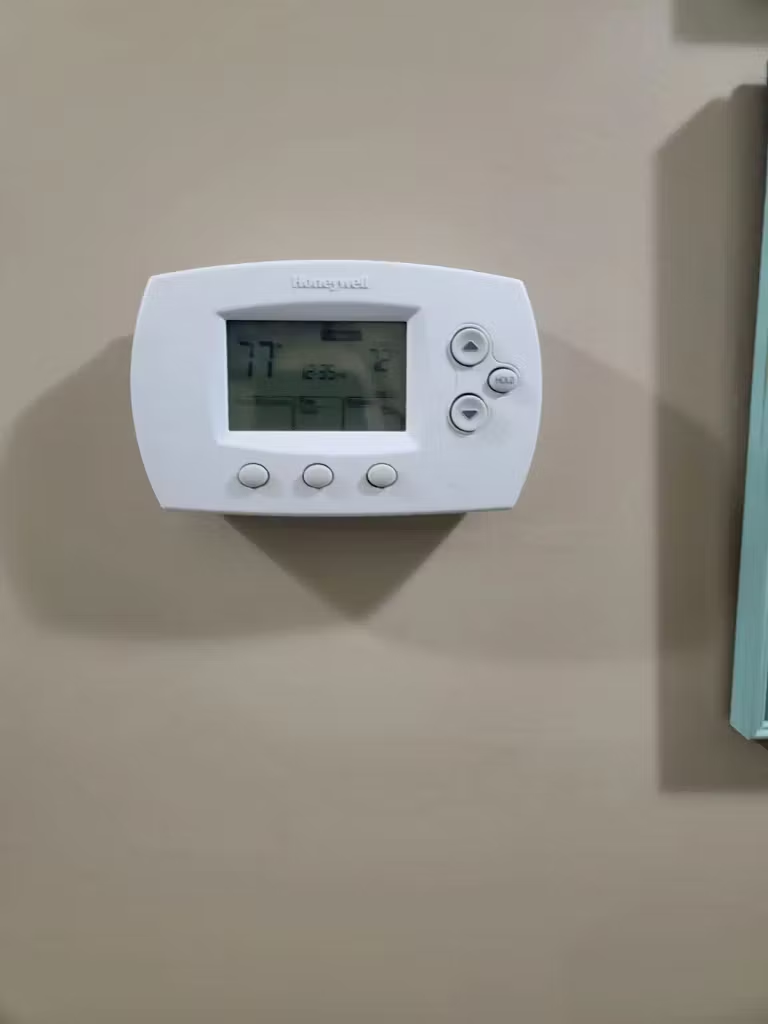
You walk past the thermostat and it's completely black. No numbers, no backlight. Your first thought: it's dead. That's the natural reaction.
Which means they're safety switches doing exactly what they're designed to do.
TL; DR
- A blank display is almost never a dead thermostat — it’s usually a tripped safety switch or power interruption caused by a furnace door, clogged drain, or blown fuse.
- Smart models with WiFi need a stable 24V C‑wire; if voltage drops below 20V, the screen will go dark even if the system runs.
- Check the furnace door, the 3‑amp or 5‑amp fuse on the control board, and the condensate pump float switch before you call an HVAC pro.
Main points
- Most blank displays are because a safety mechanism cut power — not a busted thermostat.
- The furnace door switch is the #1 culprit, especially after a filter change when the panel isn’t latched perfectly.
- A missing or weak C‑wire is the silent killer for smart thermostats; a multimeter check tells you in 30 seconds.
- That little automotive‑style fuse on the HVAC board blows more often than you’d think — and it costs under $3 to replace.
- A high‑efficiency unit with a clogged drain line will kill the thermostat to prevent a flood; it’s doing you a favor.
What Actually Causes a Blank Honeywell Thermostat Screen?
A blank screen usually results from a loss of 24V AC power, triggered by a safety mechanism like a furnace door switch, a clogged condensate drain, or a blown control board fuse. In smart thermostats, low voltage from a missing or weak C‑wire can also cause the display to go dark while the HVAC system itself continues to run.
On the surface, think of the thermostat as a dead‑bolt that won’t engage. Unless all the doors are closed. The 24‑volt signal it asks for comes from the furnace or air handler — the equipment has a bunch of ways to block that signal for safety.
Actually, let me put that more precisely, the furnace doesn’t “block” it; it opens the circuit. So a furnace door that isn’t completely flush, for example, interrupts the power loop. That’s the most common problem, bar none, and if you’ve ever struggled with a dishwasher door that calls for (depending entirely on the context) an extra shove to start.
(The same logic applies to a Bosch dishwasher display that goes dark. Because the door switch didn’t close. See how frustrating a tiny misalignment can be?
Why did the screen go dark right after I changed the air filter?
Because the furnace door or blower compartment panel isn’t fully seated, and the safety switch is still open.
Every forced‑air furnace has a little plunger switch on the door frame. Slide the panel back on and you’ll hear a distinct click. Miss that click, and the entire low‑voltage circuit stays dead — no power to the thermostat, no display. Push firmly on all four corners of the panel; even an eighth‑inch gap keeps the switch open.
How the Power System Works — and Why It Fails
Honeywell thermostats require a steady 20 to 30 volts AC (nominal 24V) from the HVAC system. Any serious drop below 20V causes a “brown‑out” that reboots the screen or leaves it black. Smart models are especially unforgiving because they pull constant power for WiFi and the backlit display, not just short control pulses.
So naturally, inside the thermostat baseplate, you’ll see terminals R. RC, RH, C, W, Y, and G.
The R (and RC/RH) terminal brings hot power. The C terminal is the common return. Older two‑wire setups don’t have a C‑wire,; or. Better put, so the thermostat steals power during off‑cycles. That trick works with dumb thermostats, but with a WiFi Honeywell.
Over the past few years, it a lot drains the batteries in weeks or causes the screen to flicker and die.
Do I really need a C‑wire for my Honeywell smart thermostat?
Yes, absolutely. Without a dedicated C‑wire providing a solid return path, the thermostat can’t maintain steady voltage.
You might get away with it for a while, but eventually the display will go dark or you’ll see low‑battery warnings that don’t make sense. If you don’t have a C‑wire terminal on your HVAC board, an external 24V transformer or a “common maker” adapter is the reliable fix.
The 7 Most Common Fixes — Step by Step
Grab a flashlight and a multimeter. Here’s exactly what to check, in order of likelihood.
- Close the furnace door firmly. Press every corner until you hear the safety switch click. This alone fixes about 40% of blank screens, especially after a filter change.
- Check the HVAC control board fuse. Look for a 3‑amp or 5‑amp automotive‑style blade fuse (purple or tan). If it’s blown, any power surge likely took it out. Replace it with the exact same amperage — don’t guess. Much like diagnosing a Jenn Air oven display that won’t light up, the first thing to trace on a control board is the fuse.
- Inspect the condensate pump or drain pan switch. High‑efficiency systems have a float switch that trips when the drain line clogs. If the pump reservoir is full, the switch kills power to the thermostat. Empty the pump or clear the clog; the screen comes right back.
- Measure the C‑wire voltage with a multimeter. Set it to AC volts, touch R and C. You should see 24V to 28V. If it’s below 20V, your transformer is weak or the wiring is undersized — that will make a smart thermostat blank out randomly. Sarah Thompson, an electrical systems engineer, puts it bluntly: “If you see less than 20 volts, your smart thermostat will eventually ‘brown out’ and go dark.”
- Check batteries and the battery compartment. Even wired models often use AA or AAA cells for backup. The low‑battery indicator on Honeywells is surprisingly subtle; you might think the unit is dead when it’s just hungry. Also, those tiny plastic pins in the battery tray bend easily. If one is crooked, you’ll get no connection. I’ve personally bent a pin while swapping batteries on a RTH9580WF — didn’t notice until the screen stayed blank. Straighten it gently with a needle‑nose pliers.
- Verify the RC/RH jumper is secure. On the backplate, a small metal jumper connects the RC and RH terminals. If it’s loose or missing, the screen won’t power up. This happens more often than you’d think after a thermostat swap.
- Wait out the 5‑minute compressor delay. After a power bump or quick cycle, many Honeywell models display a flashing icon or the word “Delay” that lasts exactly five minutes. It’s not frozen; it’s protecting the compressor. So many people mistake this for a broken screen that HVAC forums are full of “blank screen” posts that were really just the compressor lockout.
- Close the furnace door completely — ensure you hear the safety switch click on all sides.
- Replace the HVAC board fuse — use an exact 3A or 5A automotive blade; don’t substitute.
- Empty the condensate pump — clear the drain line if the float switch is raised.
- Test C‑wire voltage — touch R and C with a multimeter; 24V to 28V is healthy, below 20V needs a transformer.
- Re‑seat the batteries — check for bent pins and wipe contacts with alcohol.
People Also Ask
How do I reset a blank Honeywell thermostat?
Most Honeywells don’t have a discrete reset button. To truly power‑cycle, kill power at the furnace breaker for 30 seconds, then restore it.
If the display stays blank, that problem is power delivery, not a software glitch. Some models with removable baseplates let you pop the unit off and re‑seat it, which can clear a stuck screen.
Why does the thermostat screen flicker on and off?
Intermittent flicker almost always points to unstable voltage, loose wiring at the terminal block, a dying transformer, or a failing C‑wire connection.
Check all screw terminals on the backplate; sometimes the wire is pinched under the insulation, not the copper. A quick test with a meter during the flicker will show dips below 20V.
Can a bad thermostat battery cause a black screen?
Yes, especially in models that run primarily on battery power or that use batteries for backup. Low batteries often mimic a dead unit.
But don’t assume it’s always batteries; if you install fresh ones and the screen remains blank, move on to the door switch and fuse. Many people swap batteries and still have no display because the actual issue is elsewhere.
Is it safe to jump the R and C terminals to test the thermostat?
No, it’s risky. Bypassing the thermostat with a jumper wire between R and C can create a short or burn out the control board fuse.
Instead, use a multimeter to check for 24V between R and C. If you see correct voltage there but the thermostat won’t light up, the unit itself has failed — though that’s very rare.
How much does it cost to fix a blank thermostat screen?
If it’s a blown fuse or a door switch, under $5. A new transformer might be $30 to $60 if you know how to replace it. Calling a pro typically runs $100 to $200 for diagnostic labor.
In 90% of cases, the fix costs less than a service call fee.
FAQs
What is the first thing to check when a Honeywell thermostat screen is blank?
Push the furnace door firmly until it clicks. The safety switch is the single most common reason for a dead display, and it’s free to fix.
After that, check the HVAC board fuse and the condensate pump float switch.
How do I know if the thermostat is getting power?
Set a multimeter to AC volts and carefully touch the R and C terminals on the backplate. A reading of 24V to 28V AC confirms the thermostat is receiving steady power.
If you get zero or a flickering voltage, the problem is upstream in the HVAC unit or wiring.
Why does my thermostat keep going blank after a power outage?
The power surge may have weakened the control board fuse or the transformer. After an outage, the thermostat might work for a while, then die because the fuse is partially blown or the C‑wire connection is loose.
Replace the fuse and tighten all terminal screws; check voltage stability with the system running.
Can I fix the blank screen myself, or do I need a pro?
You can fix it yourself usually. The first seven steps I listed are all DIY‑friendly, you’re just checking safety switches and fuses, not playing with high voltage. If you determine the thermostat itself is truly dead (which is very unusual), a replacement unit costs under $50 and plugs into the same baseplate, no pro needed.
Final Thoughts: Trust the Safety Switches, Not the Screen
For the average user. Here’s the big main point from decades of HVAC face. The blank screen is rarely the enemy. It’s a messenger. When your furnace door isn’t latched, your drain pan is full.
Or your fuse is blown. The display’s job is to stay dark and protect the equipment. James Richie, a HVAC master technician, says it best. “A blank display is rarely a dead thermostat.
Fine, before you spend money on a service call. Work through these checks. I’ve personally brought back dozens of “dead” thermostats just by closing a door. Or swapping a fuse the size of a stick of gum. The same 5‑amp fuse that sometimes kills a Subaru power window can knock out a thermostat.
You fix it the exact same way. Use your multimeter, listen for that click. You’ll probably save yourself a hundred bucks today.
🔍 Research Sources
Verified high-authority references used for this article