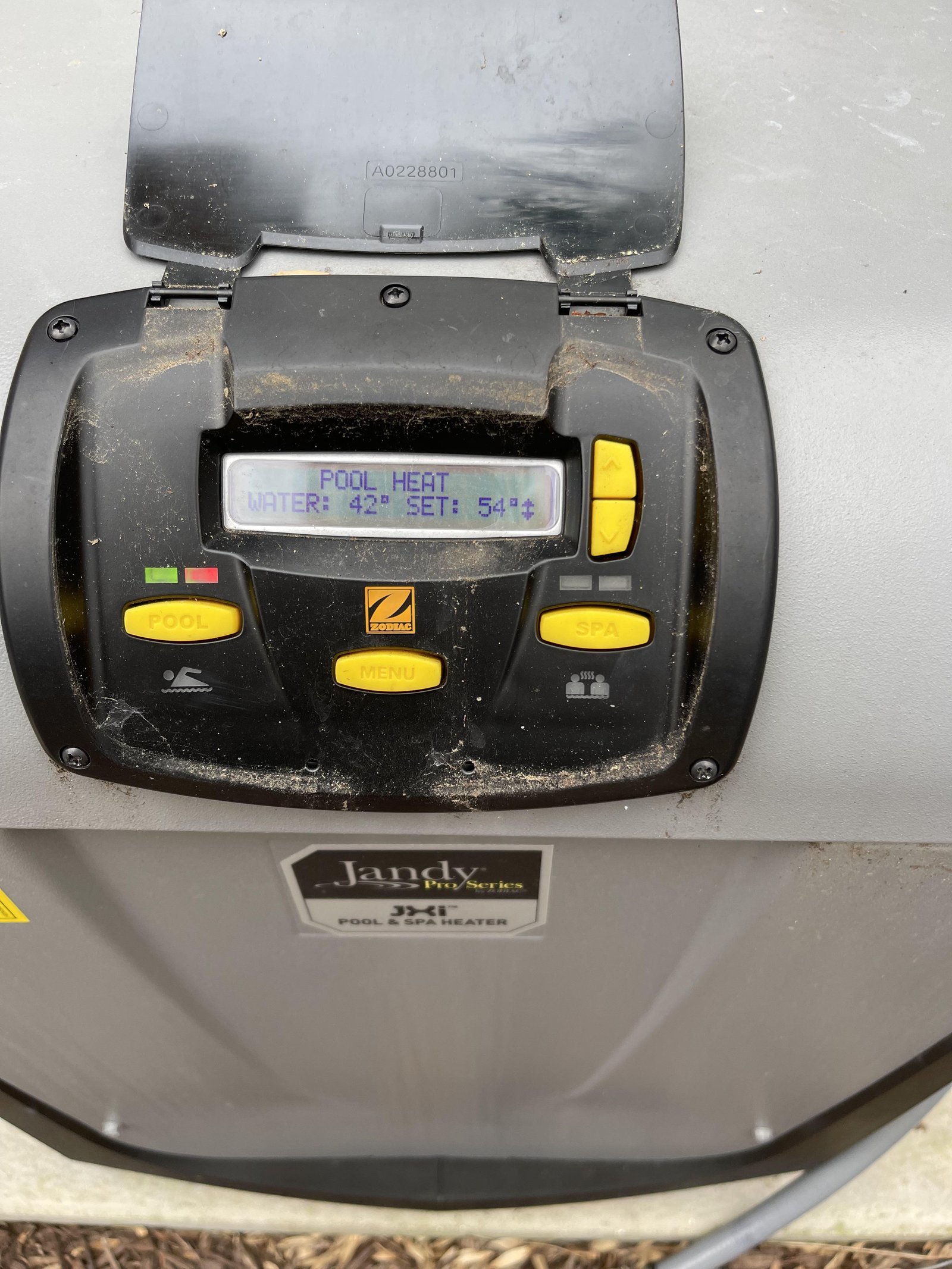
A Jandy pool heater display not working is most often caused by a loss of power or a blown fuse. Confirm the pool pump is running and the circuit breaker is set.
Why your Jandy pool heater display not working
| Cause | How common | How to confirm it | Fix it yourself? |
|---|---|---|---|
| Tripped circuit breaker | Very common | Check the electrical panel | Yes |
| Blown fuse | Common | Inspect internal board fuse | No |
| No water flow | Common | Check pump and filter | Yes |
| Loose wire connection | Less common | Check terminal block | No |
| Failed control board | Rare | No screen response | No |
| Bad transformer | Rare | No power to board | No |
Power delivery failure at the breaker
The most frequent reason for a blank screen is a simple lack of electricity reaching the heater. Your pool heater requires a steady supply of power to run the digital display and the internal computer. If the circuit breaker in your main home panel has tripped, the heater will be completely dark.
To confirm this, go to your main electrical service panel and look for the breaker labeled “Pool Heater.” If the switch is in the middle position or flipped toward “Off,” it has tripped. Move it firmly to the “Off” position, wait ten seconds, and then flip it back to “On.” If the display turns on, the issue is resolved.
If the breaker trips again immediately, don’t try to reset it again. This indicates a short circuit or a failed heating element that requires a qualified electrician to diagnose. Repeatedly forcing the breaker can melt internal wiring or cause a fire hazard.
If the breaker is fine, check the “service switch” often found on the side of the heater cabinet. This is a small toggle switch that acts as a local kill switch for the unit. Ensure it’s set to the “On” position.
Many owners mistakenly assume the heater is broken when the issue is actually a flow interlock. If your pool pump is off, many Jandy and Hayward models will display a ‘no flow’ error code on the screen to prevent the heater from firing without water flow. Always verify that your pump is running and the filter pressure is within the normal range before assuming an electrical fault. If the pump is running but the heater remains dark, check the fuse located inside the heater’s control box. A blown 3-amp or 5-amp glass fuse is a common failure point that mimics a total power loss. If the fuse is blackened or the wire inside is severed, replace it with an identical amperage rating to restore power.
Water flow and sensor interruption
A Jandy heater is designed to protect itself by displaying a ‘no flow’ error code if it doesn’t sense water moving through the heat exchanger. This safety feature prevents the unit from overheating and causing damage to the internal components. You can tell this is the cause if the pump was recently turned off or if your pool filter is clogged.
Check your pool pump to ensure it’s running at the correct speed. If you have a variable speed pump, ensure it’s set to a high enough RPM to trigger the heater’s flow switch. Most Jandy models require a minimum flow rate of 30 gallons per minute to engage the sensor. If your pump is set to a low “eco” mode, it may fail to meet this threshold.
If the water pressure in your filter is high, it may be restricting flow, which keeps the heater in a standby or “no flow” state. Check your pressure gauge; if it reads 10 PSI above your clean baseline, you must clean your filter cartridges or backwash your sand filter to restore proper flow. A common mistake is ignoring a slightly dirty filter, which costs you efficiency and triggers frequent heater lockouts.
If the pump is running and the filter is clean, but the display remains blank, the flow switch inside the heater might be stuck. This is a trade-off; while you can clean your filter, you can’t safely reach the internal flow switch without risking contact with high-voltage components. If you suspect the flow switch is the culprit, don’t open the heater housing. This is a job for a professional pool technician.
Internal board and fuse issues
A blank display can also result from a blown fuse located on the heater’s main control board. The fuse acts as a barrier to protect the sensitive electronic components from power surges. If a surge occurs, the fuse burns out and stops the flow of electricity to the display, leaving the screen dark even if the heater has power from the wall.
You can tell this is the cause if the heater has power at the terminal block but the internal board shows no signs of life. This isn’t for a beginner. Because a capacitor can hold a lethal charge even when the unit is unplugged, you must never open the housing to inspect the board. If the breaker is on and the pump is moving water, yet the display doesn’t light up, the failure is almost certainly internal.
This is where you must stop and call a professional. A service technician will confirm whether the fuse has failed or if the entire control board needs replacement. If the unit is under warranty, opening the cabinet yourself usually voids that protection immediately. Always check your warranty documentation before calling a technician to see if the repair cost is covered by the manufacturer.
The less likely causes
- Damaged display ribbon cable: The thin wire connecting the screen to the board may have come loose or corroded, which requires a technician to inspect.
- Failed transformer: If the transformer that steps down voltage to the board has burned out, the screen will stay dark; this requires a professional to test and replace.
- Corroded terminal block: Salt spray or pool chemicals can corrode the main wiring connections, requiring a technician to clean or replace the terminal connectors.
- High-limit switch fault: In some older models, a tripped high-limit switch can cut power to the control logic, necessitating a professional safety check.
What a fix usually involves
Fixing a heater display involves different levels of effort depending on the root cause. If the problem is a tripped breaker, the fix costs nothing but your time and requires only a walk to your electrical panel. If the issue is a clogged filter, you may need to spend money on new filter media or cleaning supplies, which are a small part of the total maintenance budget.
Internal failures like a blown fuse or bad control board require model-specific replacements found on your serial number plate. Contact a local pool service company for an accurate quote on parts and labor. They will provide a professional estimate to get your system running again.
Related guides