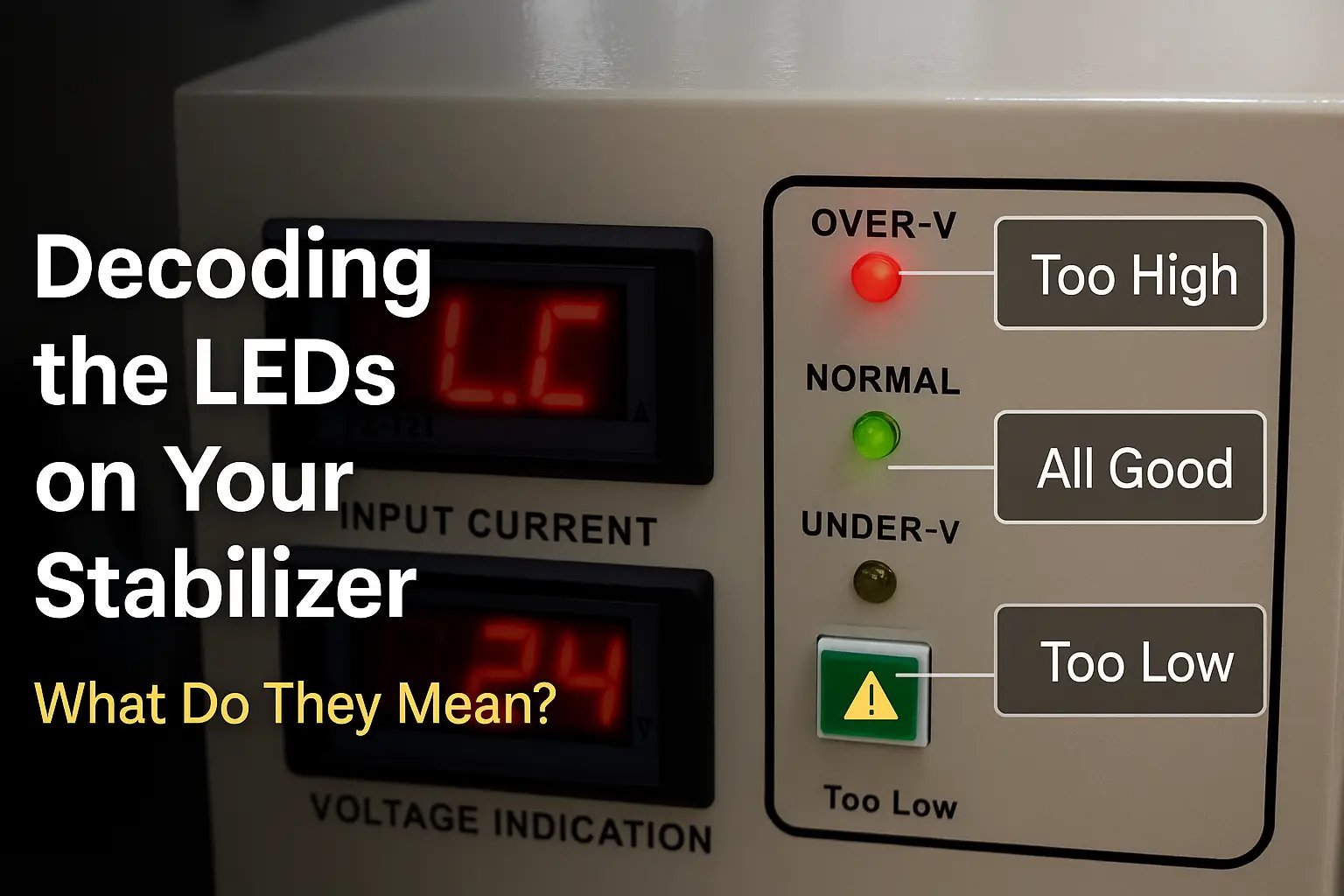
A V-Guard stabilizer output red light not working usually means the unit has no power or the internal fuse has blown. Check if other appliances in the same wall outlet are working. If the outlet provides power but the unit remains dark, the issue is likely internal. Always check your V-Guard product manual to identify the correct status lights for your model.
Why the stabilizer output light stays off
| Cause | How common | How to confirm it | Fix it yourself? |
|---|---|---|---|
| Power supply failure | Very common | Check wall outlet voltage | Yes |
| Blown internal fuse | Common | Inspect fuse status | Yes, with care |
| Loose power cable | Common | Check cable connections | Yes |
| Overload protection trip | Occasional | Wait for reset | Yes |
| Internal circuit fault | Rare | Check for burning smell | No |
| Failed indicator lamp | Rare | Check output with meter | No |
When checking the internal fuse, look for a blackened glass tube or a snapped metal wire. If the fuse is clear but the device remains dead, don’t bridge the connection with foil. This mistake creates a fire hazard that bypasses your only safety mechanism.
If the unit trips repeatedly, you have an overload. Move the unit to a dedicated circuit to stop the cycle.
Safety: Inside a mains-powered machine, the parts behind the outer cover can hold a dangerous electrical charge even after it has been unplugged — that’s why they sit behind a cover. Opening the housing, or testing or replacing anything behind it, is a job for a qualified technician, never a home repair.
Power supply connection issues
A power supply failure is the most frequent reason for a dark indicator light. This occurs when the stabilizer doesn’t receive the necessary voltage from the wall socket to trigger its internal startup sequence. If the input power is missing, the entire unit remains dormant, and the output light won’t glow even if the internal components are healthy.
To confirm this, plug a different device, such as a desk lamp or a phone charger, into the same wall socket. If the other device also fails to turn on, the problem is your home electrical circuit, not the stabilizer. You should then check your home’s main circuit breaker or fuse box to see if a switch has tripped. If the other device works perfectly, the issue lies within the stabilizer’s power cord or the connection point where the cord enters the unit.
Inspect the power cord for any visible signs of damage, such as fraying or deep cuts. If the cord looks intact, ensure it’s pushed firmly into the wall socket. If you’re using an extension cord or a power strip, remove it and plug the stabilizer directly into the wall outlet. This eliminates the possibility of a faulty extension cord causing the power drop. If the unit still doesn’t show a light after connecting directly to a verified working wall outlet, the fault is likely internal, and you should stop further troubleshooting to avoid personal injury or damage to the unit.
Blown internal fuse
A blown fuse is a common protection mechanism designed to save the stabilizer from damage during a power surge or an electrical spike. When the fuse blows, it creates a permanent break in the electrical circuit, which prevents power from reaching the output indicator and the connected load. This happens when the current drawn by your appliances exceeds the rated capacity of the stabilizer.
You can often identify a blown fuse by checking the fuse holder located on the back or side of the unit. Some models feature a clear plastic window that allows you to see the metal wire inside the fuse. If the wire is broken or the glass appears blackened or cloudy, the fuse has blown. Before replacing it, ensure your connected appliances are within the maximum wattage limit specified on the stabilizer’s label. If you decide to replace the fuse, you must use one with the exact same amperage and voltage rating. Using a fuse with a higher rating is a mistake that can lead to permanent damage to your appliances or a fire hazard. If you’re uncomfortable handling electrical components, don’t force the fuse holder open, as it can be fragile and may snap. If the fuse isn’t accessible from the outside, you should stop and contact a professional service technician.
Loose power cable or cord
A loose power cable prevents a steady flow of electricity from the wall to the internal circuitry of the stabilizer. This often happens if the unit has been moved recently or if the wall socket is worn out. If the connection isn’t tight, the internal sensors may not detect enough voltage to engage the output mode, keeping the red light off as a safety precaution.
To confirm this, grasp the plug firmly and wiggle it slightly while it’s in the socket. If you notice the stabilizer’s lights flicker or if you hear a clicking sound from the unit, the connection is definitely loose. You should also check the end of the cable that connects to the stabilizer itself. If the cable is detachable, pull it out and reinsert it to ensure a secure fit. If the cable feels loose or wobbly at the entry point of the stabilizer, it indicates that the internal connector may be damaged. In this case, you should avoid using the device and consult a professional. Don’t try to tape or wedge the cable into place to force a connection, as this can cause arcing and heat build-up. If the cable remains loose after ensuring it’s pushed in fully, it’s time to have the cord replaced by a qualified person. This fix is typically quick, but it requires the correct replacement cable specific to your model.
The less likely causes
Overload protection trip: The unit automatically shuts down output to protect itself when the connected load is too high. Check the total power usage of your appliances against the stabilizer’s rated capacity.
Internal circuit failure: A component inside the stabilizer may have reached the end of its life. This requires a technician to diagnose and replace the faulty board.
Voltage input out of range: If the input voltage is too high or low, the unit disables output. If the input light flickers, your local grid is unstable.
What a fix usually involves
Fixing a stabilizer depends entirely on the nature of the fault. If the issue is a simple external connection, the cost is nothing beyond your time to move or tighten the cables. Replacing a blown fuse is also a low-cost repair, requiring only the price of a small part that matches your unit’s specifications. However, if the fault is internal, the repair involves opening the housing and testing individual components, which is a job for a professional technician.
The cost for professional help depends on the specific brand, the age of the unit, and whether you need genuine spare parts. Before authorizing any work, ask the service center for an estimate. Most authorized centers will provide a quote after a brief inspection. If the cost of the repair approaches most of the price of a new one, consider replacing the unit instead of fixing it. Always verify your warranty status first, as unauthorized repairs will void any remaining coverage you may have.
Frequently asked questions
Can I leave the stabilizer on if the red light is off?
No, you should turn the stabilizer off and unplug it if the red light isn’t working. The light indicates that the unit is actively regulating and providing power to your appliances. If it’s dark, the unit may be in a fault state or failing to deliver the correct voltage, which could damage your expensive electronics.
How long does it take for a stabilizer to reset?
About 30 seconds to 5 minutes is typical for most modern stabilizers to reset after a power cut or an overload trip. If your unit doesn’t show a light after waiting for this time, it isn’t resetting automatically. Check your manual to see if your model requires a manual reset switch or button.
Is it safe to use a higher amp fuse?
No, you must never use a fuse with a higher amperage than what the manufacturer specifies on the label. The fuse is a safety device designed to break the circuit before your stabilizer or appliances overheat. Using a higher rating is a mistake that removes this protection and can lead to a fire.
What happens if I ignore the dark light?
If you ignore the dark light, you risk running your appliances on unstable, unregulated power or no power at all. If the stabilizer is faulty, it may pass raw input voltage directly to your appliances, which can destroy sensitive electronics. It’s always safer to resolve the power issue before connecting any equipment.
Does it matter if the wall socket is old?
Yes, a worn-out wall socket can cause a loose connection that prevents the stabilizer from getting steady power. If the socket feels loose when you plug the device in, or if the plug falls out easily, the socket is likely the cause of the problem. Replace the wall socket to ensure a secure electrical connection.
Why is there a clicking sound?
The clicking sound is usually the internal relay engaging or disengaging as the stabilizer attempts to regulate the voltage. If the clicking continues without the output light turning on, the unit is struggling to find a stable voltage level. This often happens if the input power is extremely unstable or if there’s an internal fault.
Final Thoughts
If the light stays off after you’ve checked the connections, it’s best to contact a certified technician rather than opening the casing yourself. They’ll have the right tools to safely inspect the internal wiring. You shouldn’t risk a shock, so let a professional handle the repairs to keep your appliances safe.
Related guides