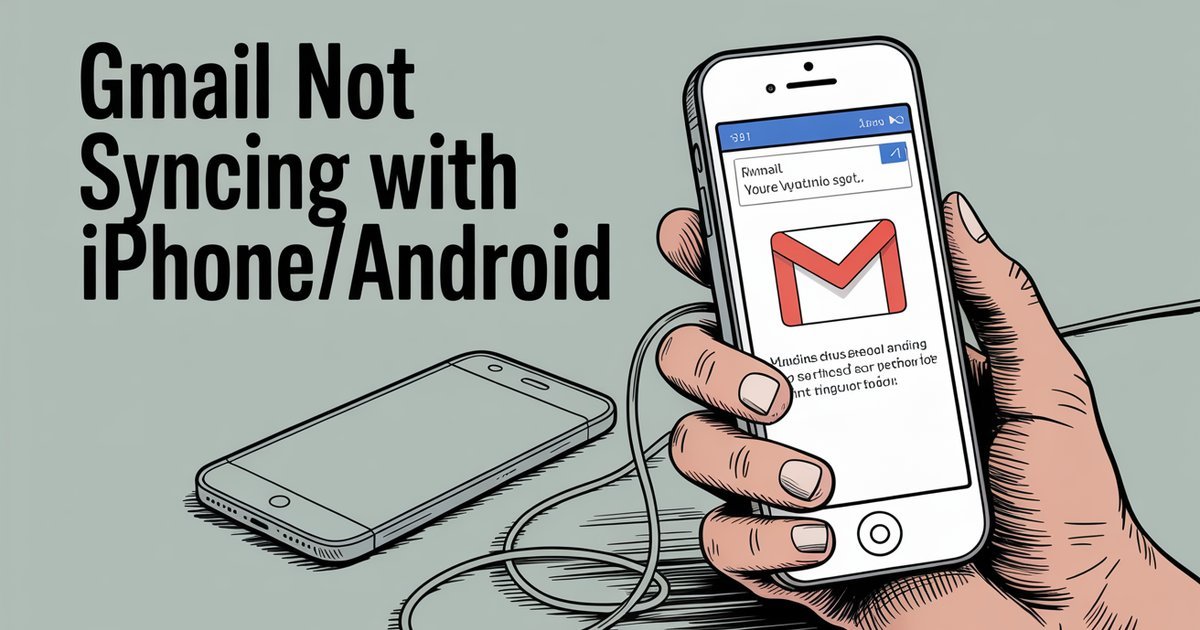
The most likely reason your iphone not syncing gmail is that your account settings are configured to fetch data manually rather than push it automatically. In most cases, you can confirm this by checking your Mail settings under the Accounts menu to see if the Fetch New Data option is set to Push or Fetch. This is a common software configuration issue that affects how often your device reaches out to Google’s servers to retrieve new messages.
Fixing an iPhone not syncing Gmail
| Cause | How common | How to confirm it | Fix it yourself? |
|---|---|---|---|
| Fetch settings | Very common | Check Settings > Mail > Accounts | Yes |
| Password expired | Common | Mail app shows an error | Yes |
| Offline mode | Common | No connection icon present | Yes |
| Disabled sync | Rare | Check account toggle switches | Yes |
| Server outage | Rare | Check Google Workspace status | No |
| App cache error | Rare | App behaves very slowly | Yes with care |
Incorrect mail fetch settings
Incorrect fetch settings are the leading cause of sync delays on iOS devices. When your phone is set to “Manual,” it will only check for new emails when you physically open the Mail application. This is a power-saving feature that prevents the phone from constantly using background data. If you need your mail to arrive in real-time, you must change this setting to “Push” or ensure “Fetch” is set to run at a specific interval.
To check your current configuration, navigate to the Settings app on your iPhone and select Mail. From there, tap on Accounts and then choose Fetch New Data at the bottom of the screen. If you see the setting labeled Manual, your phone is waiting for your input before it connects to the Gmail servers. Change this to Automatic or set a schedule, such as every 15 minutes, if you prefer to save battery life.
This adjustment takes about two minutes of your time and requires no extra tools or software. If you have multiple accounts, you can customize these settings for each one individually. Keep in mind that setting your mail to “Push” for every account may consume more battery power throughout the day. This varies by model — check the label on your battery health status if you notice your phone dying faster after changing these settings. If you’re still seeing delays after selecting Push, ensure your iPhone isn’t in Low Power Mode, as this feature automatically disables background mail fetching to extend battery life.
Authentication errors and account credentials
An authentication error occurs when your Google account password has been changed or the security token has expired, causing the iPhone to lose its connection to the server. You’ll usually see a notification in the Mail app or a pop-up prompt asking you to re-enter your credentials. This happens frequently after you update your password on a computer or if you have enabled two-factor authentication without updating your device’s security settings.
To fix this, go to Settings, tap Mail, and select Accounts. Tap on your Gmail account and look for a prompt that says “Re-enter Password” or “Account Error.” If you don’t see this, try toggling the Mail switch off and back on to force a re-authentication request. Once you tap the switch, the system will prompt you to sign in through the official Google web portal.
This process is straightforward, but you must have your current Google password ready. If you have forgotten your password, you’ll need to reset it through the Google Account recovery page before your iPhone can sync again. A common mistake people make is trying to force a sync by repeatedly closing and reopening the app; this doesn’t fix an expired token and only wastes your time. If you suspect your account is locked, don’t try to guess your password multiple times, as this may trigger a temporary security lockout from Google.
Network connectivity and offline status
Network connectivity issues often prevent the Mail app from reaching the server, even if your phone appears to have a signal. Your iPhone might be connected to Wi-Fi, but the connection could be restricted or the device might be stuck in a “ghost” offline state. You can tell if this is the cause by opening Safari and checking if you can load a new website. If the web page fails to load, the problem is your internet connection rather than your email settings.
To resolve this, toggle your Airplane Mode on for ten seconds and then turn it off again. This forces your iPhone to drop all current connections and re-establish a fresh link with the nearest cell tower or Wi-Fi router. If you’re on a public Wi-Fi network, try switching to cellular data to see if the mail begins to sync immediately.
This quick diagnostic step costs nothing and takes under a minute. If you’re using a VPN, it might be blocking the connection to Gmail’s servers. Try disabling your VPN temporarily to see if the sync resumes. If you have checked your internet, toggled Airplane Mode, and verified your Wi-Fi, but the mail still doesn’t appear, the issue might be a temporary restriction on the network you’re using.
The less likely causes
Storage limits: Your iPhone storage is full, preventing the Mail app from downloading new message headers or attachments. Check Settings > General > iPhone Storage; if you have less than 500MB of free space, the system will throttle background data fetches to prioritize core OS stability.
App corruption: The Mail app itself has a background process error that requires a full device restart to clear. A simple app close is insufficient here; perform a hard reboot by quickly pressing volume up, then volume down, then holding the side button until the Apple logo appears.
Software updates: Your iOS version is outdated and no longer compatible with the latest Google security protocols. If you’re running a version older than iOS 15, Google’s modern OAuth authentication may fail, requiring a full system update to restore secure token handshakes.
Account restrictions: Your organization or school account has specific IT policies that limit how often mobile devices can sync. If your account is managed via a Mobile Device Management (MDM) profile, check if “Background App Refresh” is disabled by your administrator. If the sync interval is set to “Manual” or “Hourly” by policy, you can’t override this through standard Mail settings.
What a fix usually involves
Fixing sync issues involves a balance between time and technical effort. Most of the time, you only need to adjust settings within the iOS menu, which costs nothing and takes only a few minutes. If the problem is related to your account credentials, you’ll need your login details and a stable internet connection to re-verify your identity with Google. A small part of these issues may require you to remove and re-add the entire email account, which deletes the local cache of your mail but doesn’t remove the messages from the server.
If you find that your mail app is completely broken, the cost of a professional repair is usually unnecessary; you can often resolve this by deleting the app and downloading it again from the App Store. When you aren’t sure if a setting is correct, check the official Apple support documentation for your specific iOS version. This ensures you’re following the right steps for your hardware. If you still can’t get it to work, contact your service provider to see if there’s a known service outage in your area.
Frequently asked questions
Can I fix this without deleting my account?
Yes, most sync issues are solved by simply toggling the Mail switch off and on in your account settings. This forces the device to refresh its connection to the server without removing your data. If this doesn’t work, check your fetch settings to ensure they aren’t set to manual, as this is the most common reason for perceived sync failures.
Why does my mail only sync when I open the app?
This happens because your iPhone is set to fetch mail manually to save battery life. You can change this behavior by going to Settings > Mail > Accounts > Fetch New Data and selecting “Push” or a specific time interval. This ensures that the phone checks for new messages in the background even when you aren’t using the application.
Is it safe to remove and re-add my Gmail account?
Yes, it’s completely safe to remove and re-add your Gmail account from your iPhone settings. Your emails are stored on Google’s servers, so deleting the account from your device only removes the local copy from your phone. Once you sign back in, the Mail app will automatically download your messages again from the cloud, and no data will be lost.
How long does it take for mail to sync on push?
About a few seconds is the standard time for an email to arrive when “Push” is enabled. However, this depends on your internet speed and the current load on Google’s servers. If you’re on a slow cellular connection, you might notice a delay of several minutes before the notification appears on your screen, even if the settings are configured correctly.
Does it matter if I use the Gmail app or the Mail app?
Yes, it matters because the official Gmail app uses a different sync method that’s often faster than the default iOS Mail app. If you continue to have trouble with the built-in Mail app, downloading the Gmail app from the App Store is a reliable way to ensure your messages arrive in real-time. Both apps can coexist on your phone without any conflicts.
What happens if I am in Low Power Mode?
If your iPhone is in Low Power Mode, it will automatically disable background mail fetching to preserve battery. This means your phone will stop syncing your Gmail account until you either plug it into a charger or turn off Low Power Mode. You can check your battery status in the top right corner of your screen to see if this mode is currently active.
Final Thoughts
If these adjustments don’t solve the problem, try removing your account entirely and adding it back through the Settings app. This simple refresh often clears out lingering glitches that prevent your inbox from updating. You’ll find that your emails start arriving reliably again once the connection is properly re-established.